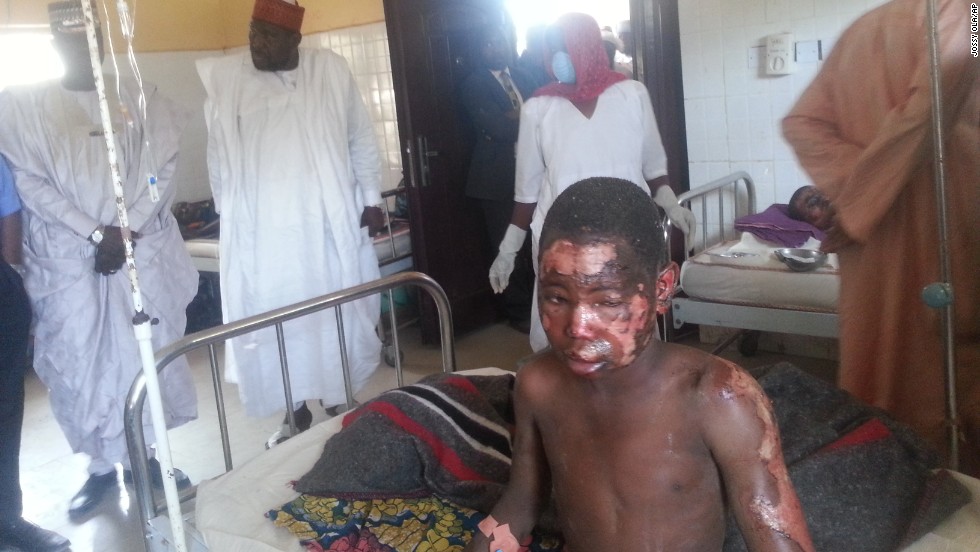
Nigeria Boko Haram disaster: UN aid convoy ambushed
Suspected Islamist Boko Haram militants have ambushed an UN
humanitarian aid convoy in northeastern Nigeria which had a military escort, officials say.
The military said three civilians, including UN staff, and two soldiers were wounded in the assault.
It's prompted aid deliveries to be briefly suspended by the UN in Borno state, where the insurgency has displaced more than two million people.
The UN says thousands of children are severely malnourished in the region.
Earlier this month the UN's children agency warned that tens of thousands of kids would die if treatment didn't reach them shortly.
Islamist militant group Boko Haram, which has lost most of the territory it controlled 18 months ago, is fighting to overthrow the government.
Its seven-year insurgency has left 20,000 people dead, mainly in the nation's northeast.
The wounded are in a secure condition and are being treated in hospital in the state capital Maiduguri, according to a statement in the military.
"The convoy was travelling from Bama to Maiduguri in Borno State... returning from delivering desperately needed aid" at the time of the ambush, Unicef said.
"This wasn't only an attack on humanitarian workers. It's an attack on individuals who most need the assistance and aid these workers were bringing," it added.
Boko Haram never actually went away, contrary to the Nigerian authorities saying that the group had been conquered "technically" or even "decisively".
Nigeria and its neighbours has definitely weakened in the combined military offensive the group, losing swathes of land in Nigeria's north-east.
But assaults against security forces and
civilians have seen a resurgence in recent months. The assaults have even been encouraged by media outlets of the so called Islamic State, to which the leaders of Boko Haram have sworn allegiance.
It does not help that Nigeria is now fighting a separate battle against oil militants in the southern Niger Delta area.
UN suspends aid to dangerous places of northeast Nigeria
LAGOS, Nigeria — The United Nations is freezing assistance to dangerous areas of Nigeria’s northeastern Borno state, where it says after a humanitarian convoy was ambushed by Boko Haram a half million people are starving.
Three civilians including an UNICEF employee and contractor for the International Organization for Migration were wounded in Thursday’s ambush, along with two of the soldiers escorting the humanitarian workers, according to the Nigerian army and the U.N. Children’s Fund.
"Merely the U.N. missions outside the capital have been frozen," UNICEF spokeswoman Doune Porter told The Associated Press on Friday. "The normal aid we've been giving will continue in Maiduguri," the Borno state capital of 1 million individuals that hosts another million refugees from Nigeria’s 7-year old Islamic insurgency.
This was not only an attack on humanitarian workers. It is an assault on the people who most need the support and help these workers were bringing," Porter said.
The convoy that was attacked was going from the city of Bama, just freed from Boko Haram, where Doctors Without Borders has warned that children are dying every day with 15 percent enduring serious acute malnutrition and likely to die without food and medical aid.
More than 500,000 people are suffering a "catastrophic crisis" in that was humanitarian dangerous-to-reach areas, said the physicians.
A Doctors Without Borders vehicle traveling with a military escort set off a land mine before this week a number of kilometers (miles) from the scene of Thursday’s ambush but no one was hurt, according to soldiers who were there. They spoke on condition of anonymity because they're not authorized to speak to reporters.
Some Boko Haram combatants who surrendered have reported the militants are running out of arms, fuel and food, the military has stated, saying they've cut off the insurgents’ supply lines.
Military spokesman Col. Sani Kukasheka Usman said the insurgents were hiding in Meleri hamlet near Kawuri, the official entrance to the sprawling Sambisa Forest that's been a Boko Haram stronghold. The military warned earlier this month that Boko Haram fighters were fleeing its daily aerial bombardments and ground attacks in the woods, heading toward the border with Cameroon.
The uprising by Boko Haram, which joined the Islamic State group last year, has killed more than 20,000 people, forced more than 2 million from their homes and distribute across Nigeria’s edges to Cameroon, Chad and Niger.
U.N.: Nearly 50,000 children at risk of starvation due to Boko Haram campaign
Nearly a quarter of a million children are severely malnourished in one state in northeastern
Nigeria, where a violent effort kept help groups away and by Islamist extremists has displaced a lot more than a million people, a major international group reported.
Based on the UNICEF report, about 50,000 of the youngsters will expire if they don’t receive food and medical attention shortly.
The report focused on Borno state, which has endured the worst of Boko Haram’s strikes and mass kidnappings. Yet while those offenses are known — particularly the kidnapping of more than 200 schoolgirls from the town of Chibok — the massive humanitarian impact of the group’s effort has received much less attention.
Northeastern
Nigeria is now the site of among the world’s biggest displacement crises, with more than 1.4 million individuals having been compelled to flee their houses. But because the area is inaccessible and dangerous, it receives relatively little international assistance. Nigeria’s own assistance equipment has a small record of effectiveness, plus some pros say severe mismanagement plagues it.
There are 2 million folks we're still unable to reach in Borno state, which means the true scope of this disaster has yet to be shown to the world," said Manuel Fontaine, UNICEF’s director for West and Central Africa. None of us are capable to work that we need, although "There are organizations on the ground doing great work. We must all scale up."
Along with the displaced, many of those facing acute food shortages relied on farms that raided or have been destroyed by Boko Haram combatants. The malnutrition crisis was exacerbated by the failure of government services in places where the insurgents have been active.
70 percent of the water infrastructure in Borno and thirty percent of health facilities has been ruined or damaged, based on the United Nations.
Starting in 2011, Boko Haram took over enormous amounts of land in Nigeria and went into neighboring Cameroon and Chad. The Nigerian military has dislodged the fighters from most of their strongholds. But the insurgents have kept their ability to consistently strike at soft targets, such as displacement camps or mosques. That's caused it to be challenging for many
assistance groups to manage.
"Though many of these areas are no more under Boko Haram control, they truly are still dangerous said Doune Porter, a spokeswoman for UNICEF in Nigeria.
At one displacement camp in the city of Bama, the aid group Doctors Without Borders reported last month that individuals were dying of starvation.
UNICEF has appealed for $55.5 million to react to the disaster in northeastern Nigeria but has received just $23 million.
All the humanitarian actors are under-resourced and underfunded, and it’s an exceptionally hard issue," Porter said.
MAIDUGURI, Nigeria — In miniature thatched huts, they were kept for months in the middle of the forest, waiting with anxiety each evening for their rapists to return. During the violence that is nearly intolerable, the young women’s heads wandered to death or escape. The victims were as young as 8.
At the heart of Boko Haram’s self-proclaimed caliphate in northeastern Nigeria was a savage campaign of rape and sexual slavery that's just recently been uncovered. Thousands of girls and women were held against their will, subject to forced marriages and relentless indoctrination. Those who resisted were often shot.
Many of the women are suddenly free — rescued in a series of Nigerian military operations in the last year that dislodged the extremist Islamist group from most of the land it controlled. But there have been few joyous family reunions for the casualties.
Most of the surviving girls no more have homes. Their cities were burned to the earth. The military has gently deposited them in displacement camps or deserted buildings, where armed men leery of their loyalties monitor them. They're still labeled "Boko Haram wives."

When Boko Haram kidnaped 276 schoolgirls few could have imagined such an outcome two years ago and the world responded with the Bring Back Our Girls campaign. Many
people assumed the other kidnapped women would be welcomed back, while most of those schoolgirls from Chibok are still missing.
Instead, they're shunned.
For seven months, Hamsatu 25, and Halima, 15, were among Boko Haram’s sex slaves, raped almost each day by exactly the same unit of combatants in the remote Sambisa Forest. Now, they live in a narrow, white tent in a camp that is displacement, with empty cement bags sewn together to create a drape. The girls spoke on the condition that their full names were not used in order to describe their experiences.
When Halima leaves the tent to get food for the two of them, the other people living in the camp scowl at her or carefully move away.
You ’re the person who was wed to Boko Haram," one old girl spat at her recently.
"We can’t trust any of them," said one guard.
Authorities say there are good reasons for his or her wariness. This past year, 39 of 89 Boko Haram suicide bombings were carried out by women, in accordance with UNICEF. Twenty one of those female attackers were from villages and cities apparently abducted under the age of 18, many of them ladies and converted into assassins. In markets, mosques as well as displacement camps, female attackers have killed hundreds of individuals across northeastern Nigeria, since January.
No one knows exactly why some women who were captured and mistreated became killers. Maybe it was the indoctrination. Maybe it was the ’ threats that are militants.
The job of reintegrating the displaced, either way has become immensely more complicated for
Nigerian authorities.
And for survivors attempting to move ahead from a terrible chapter in their lives, there's now a new torment.
"There is no trust here," said Hamsatu, wearing the identical pink and crouching in her tent , flowery dress she had on when she was kidnapped 18 months past. In her arms, she held the baby of her captor.
It was September 2014 when Boko Haram combatants took over Hamsatu’s and Halima’s house city of Bama , near the Cameroonian border. Many of the 350,000 residents managed to flee. But the combatants instantaneously began killing the man civilians who couldn’t escape. Some were shot in their houses. Others were beheaded and thrown in mass graves.
With a group of about 25 other girls, Hamsatu and Halima say, they were transferred by the militants from home to home and then driven to go on foot and on the backs of bikes to the Sambisa Forest, where Boko Haram had set up camps for the sex slaves.
The women were each assigned to a sliver of a hut, barely big enough to lie down. Hamsatu said that days later, one combatant, whose name she never learned, entered the hut and said a prayer in what sounded to her.
Now they were wed, he told her. She thought of her real husband, who had been missing since the day Boko Haram stormed Bama.
"I do n’t understand if he’s alive," she said.
Video promises to reveal Nigerian girls kidnapped by militants two years ago
A video purporting to reveal some of the more than 200 girls kidnapped by Nigerian-based Islamist militant group Boko Haram has surfaced on the abduction’s second anniversary.
In the video, thought to have already been made in December and got by CNN, 15 girls are expressionless as they state their names to a man heard off camera.
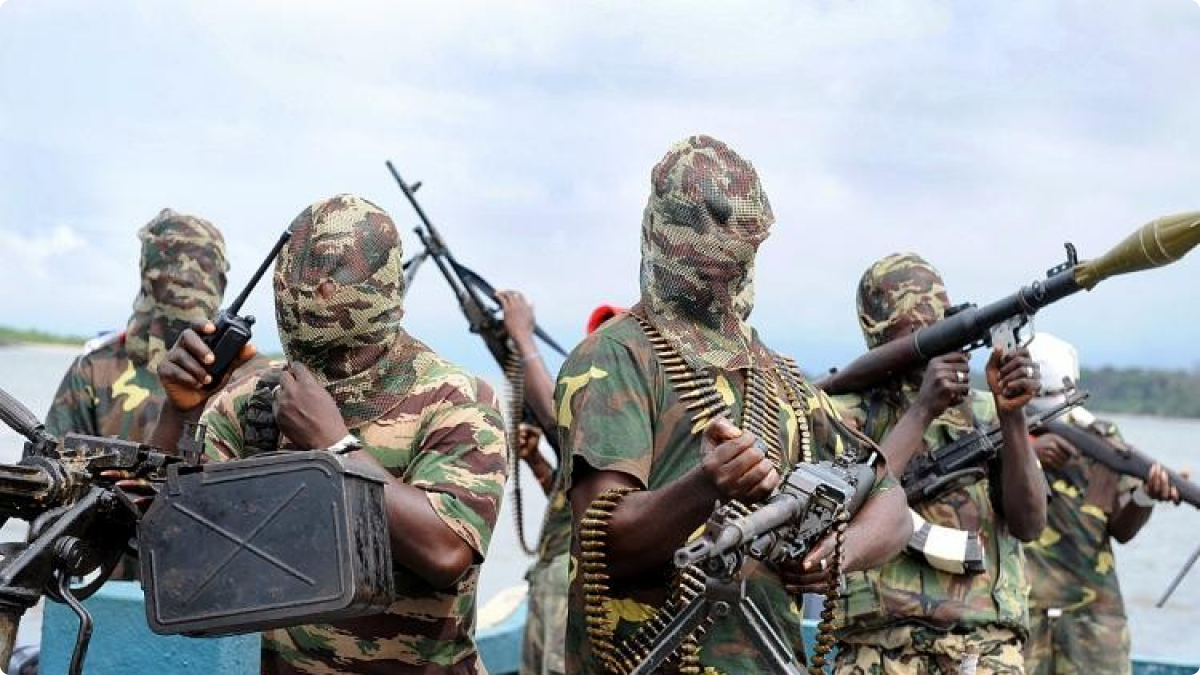
"We are all nicely," said one of the girls in the video, first broadcast Wednesday. She then supported the
Nigerian government to fulfill Boko Haram’s demands, which weren't stated.
CNN reported that the video was made as "part of dialogues between the government and Boko Haram."
Although
Nigerian officials have alluded vaguely to discussions that were possible, there have already been few clear details as the militants continue to wage strikes. The kidnapping of the 276 schoolgirls got worldwide attention, and Muhammadu Buhari, Nigeria’s president, vowed to bring them home. Several girls managed to escape, but 219 are lost.
The last time the girls were seen freely was in a May 2014 video released by Boko Haram. In Nigeria, rumors have swirled over their potential fate. Some girls held by Boko Haram in other regions have described a widespread campaign of sexual abuse and forced marriages.
The just released video shows the lost girls with head scarves that are fluid that conceal everything but their faces.
Despite the sketchy info provided in the video, Nigeria’s Lai Mohammed, information minister, told CNN the girls in the video appeared "under no strain whatsoever."
CNN also spoke to mothers and a classmate of the kidnapped girls, who said they recognized the young women in the video. I felt like removing her from the screen, " said Rifkatu Ayuba, whose daughter was among the 15 girls shown.
Although Boko Haram in modern times has kidnapped thousands of people, the girls, taken in the northeastern town of Chibok, became an international symbol of the conflict. The Usa has dispatched military trainers and surveillance drones, and activists around the world united on social media behind the hashtag #BringBackOurGirls.
"Two years on, the Chibok girls have come to symbolize all the civilians whose lives are devastated by Boko Haram," said Amnesty International’s
Nigeria director, M.K. Ibrahim.
The United Nations is helping to support some of the individuals who escaped in the Islamist group, many of whom live in buildings that are abandoned and sprawling displacement camps.
The girls are presumed to maintain the remote Sambisa forest in northeastern Nigeria. Although the country’s military has dislodged militants from towns and cities, a search and rescue operation in the woods is thought to be far more challenging.
The video’s broadcast coincided with a report by the U.N. kids’s agency UNICEF accusing Boko Haram of dramatically raising the use of child suicide bombers — with girls accounting for more than three quarters of them — in Nigeria, Cameroon and Chad. Some of the girls are believed to happen to be kidnapped by the extremists.
Boko Haram is compelling more kids to execute suicide bombings
In the last two years,
Boko Haram militants have increasingly turned to a brand new approach in their attacks in West Africa: kid suicide bombers.
How many children involved in such blasts grew more than tenfold, from four in 2014 to 44 in 2015, based on a report released by the U.N. kids’s agency on Tuesday. And more than three quarters of the kids are girls — some as young as 8 years old.
Another view that is chilling is added by the statements by UNICEF into the atrocities attributed on the Boko Haram group, which has conducted mass kidnappings of children, including more than 200 school girls abducted from a boarding school in northern Nigeria.
Women and some girls who escaped have claimed that prisoners face sexual abuse and forced marriages.
"Let us be clear: These children are victims, not " said UNICEF’s regional director for Central and West Africa, Manuel Fontaine , in a statement. " Deceiving children and compelling them to carry out acts that are fatal has been among the most horrific aspects of the violence in Nigeria and in nearby states."
Offensives by security forces in Nigeria, Cameroon and Chad have compelled the Islamist group from most of the land it once controlled. In response, Boko Haram has ran a growing variety of assaults on civilian targets, killing hundreds of people in recent months.
The report also represents Boko Haram’s push in the last couple of years outside its former strongholds. Nearly half the kid suicide attacks, 21, were in neighboring Cameroon, it said.
But international aid groups and both
Nigerian officials have struggled to explain the reason behind the upsurge in kid attackers.
The rise in Boko Haram’s instance is stunning, although youthful suicide bombers are used in other conflict zones. 20 percent of suicide bombings carried out by the group have been kids, based on UNICEF.
Boko Haram from their houses abducted some of the kids, and their bodies were identified afterwards from remains after suicide attacks. A young girl blew herself up killing at least 22 individuals, last month. Her identity hasn't yet been established.
The Nigerian military, because of its part, has come to treat kids abducted by Boko Haram as risks no distinct from adults. Boys have appeared on "wanted posters" across northeastern Nigeria — once the stronghold for the group — along with dozens of top Boko Haram suspects.
"Banditry knows no age," said Maj. Gen. Lucky Irabor, the top military official in the northeast, when a Washington Post reporter asked about the boys on the poster.
But according to UNICEF, many of the assaults are ran involuntarily. "Lads are compelled to attack their own families to demonstrate their devotion " the report said.
The group has, meanwhile, taken captive a huge selection of girls.
"The considered use of children, who may have already been coerced into taking bombs, has created an atmosphere of mistrust and concern that's disastrous effects for girls that have survived sexual and captivity violence by Boko Haram in North East Nigeria, UNICEF’s report was said by ".
In a separate report from Human Rights Watch Tuesday released, researchers said that "Nigeria’s security forces have led to the issue by utilizing schools as military bases, placing children at additional risk of assault from your Islamist armed group."
Human Rights Watch also reported that "at least 611 teachers happen to be purposefully killed."
Almost 1.3 million schoolchildren have been displaced by the conflict, according to UNICEF, including 5,000 kids separated from their parents.
And violence just isn't the only threat facing youngsters in the region. By January, 195,000 children were suffering from severe acute malnutrition.
Army says no more Boko Haram camps
The Acting Director, Army Public Relations, Col. Sani Usman, said there were no camps of
Boko Haram terrorists in the northeastern part of the nation anymore.
He said: "The situation in the North-East has enormously improved. The military operations or the fight against insurgency and terrorism in the North East is hinged on three things.
Based on the News Agency of Nigeria (NAN), Usman, who revealed this yesterday while addressing newsmen at the inauguration of Strategic Communication Lessons for senior officers at the Nigerian Army School of Public Relations and Information, Bonny Camp, Lagos, said the military was winning the war against terrorism.
"First, conquering the Boko Haram terrorists which were actioned and making room to facilitate humanitarian assistance which is also on-going.
"Then restoration of order and law for good government to happen.

"We no longer have we no more have them in the lands and camps of Boko Haram terrorists."
On the inauguration of the communication class, Usman said that training of staff was predominant, including that it would enrich proficiency.
He thanked the Chief of Army Staff, Lt.-Gen. Tukur Buratai, for improving the Nigerian Army formations.
Also, the NASPRI Commandant, Col. John Agim, said the course was to better equip senior officers who were saddled with the responsibility of shaping the information environment.
I encourage one to take advantage of the training to enhance your ability in public relations As you settle down to confront the rigours of the course.
"Also, improve your capability and by extension in the field of arms", Agim said.
Boko Haram Ambush: Military yet to verify variety of soldiers
Not less than 10 soldiers are said to be missing in action, when troops of the Nigeria Army walked into an ambush laid by Boko Haram insurgents on Thursday morning. The authorities of the Nigeria Army are to confirm the number.
But a statement issued by the Acting Director, Army Public Relations (Ag.DAPR) Col Sani Usman, confirmed that soldiers returning from an effective operation seen the insurgents, inflicted casualties on them, but "a few others were missing in action."
A source told The Guardian that the lost soldiers were in the thick of action, before the ambush but you cannot start to look out for everybody when you are trading fire.
 So it was a difficult
circumstances "The terrorists attacked in their own amounts, the troops were taken unawares, but the actual figure would be made public soon," the source said.
The statement "Troops on clearance patrol at Guro Gongon village and environs to rout out remnants of
Boko Haram terrorists hibernating therein, destroyed makeshift camps are ’ed by the terrorists and recovered fairly quite a few weapons, gear and foodstuff along the way.
"Yet, the gallant soldiers basking on the recorded success, returning to their defensive places, ran into an ambush by an organization of Boko Haram terrorists who came to fortify their comrades that are fleeing.
Northern group needs amnesty for Boko Haram
A group, the Northern Inter faith and Religious Organisation for Peace (NIROP), has reiterated call for an amnesty programme for repentant members of the Boko Haram sect.
The group also commended President Muhammadu Buhari for the absorption of members of the local vigilance outfit, also called Civilian Joint Task Force (CJTF), into security agencies.
National Coordinator of NIROP, Bishop Musa Fomson, who spoke with reporters in Abuja, yesterday, said: "We desire to suggest that the authorities firmly consider granting amnesty to members of Boko Haram that are not high up in its command structure, as an incentive to make them drop their weapons without
additional human toll.
"What's on trial here is our humanity. Departures are being recorded on all sides, even as the war on terror reaches the advanced phase of clearing out remnants of the sect. A motivator from putting up stiff fight to stop the remaining terrorists, is really to support surrender. This should especially target the non-combatant elements of the terror group and those that were coerced into joining the sect."

NIROP, however, warned the amnesty should focus on demobilising Boko Haram members "and mustn't be converted into a money. It should also be monitored in a way it is possible to keep track of those that sign up for the deal."
Bishop Fomson said: " absorption and Their training into the Nigerian Army and other agencies is a verification that the fight against terrorism has reached the stage where homegrown remedies have to be engineered. The concern has been how to disarm and demobilise the youths, after they have been compelled to carry arms. Those raising the concern were afraid of what would occur when Boko Haram has been totally conquered by the military. The youths could become a source of difficulty although they have the abilities to fight but aren't gainfully applied."


